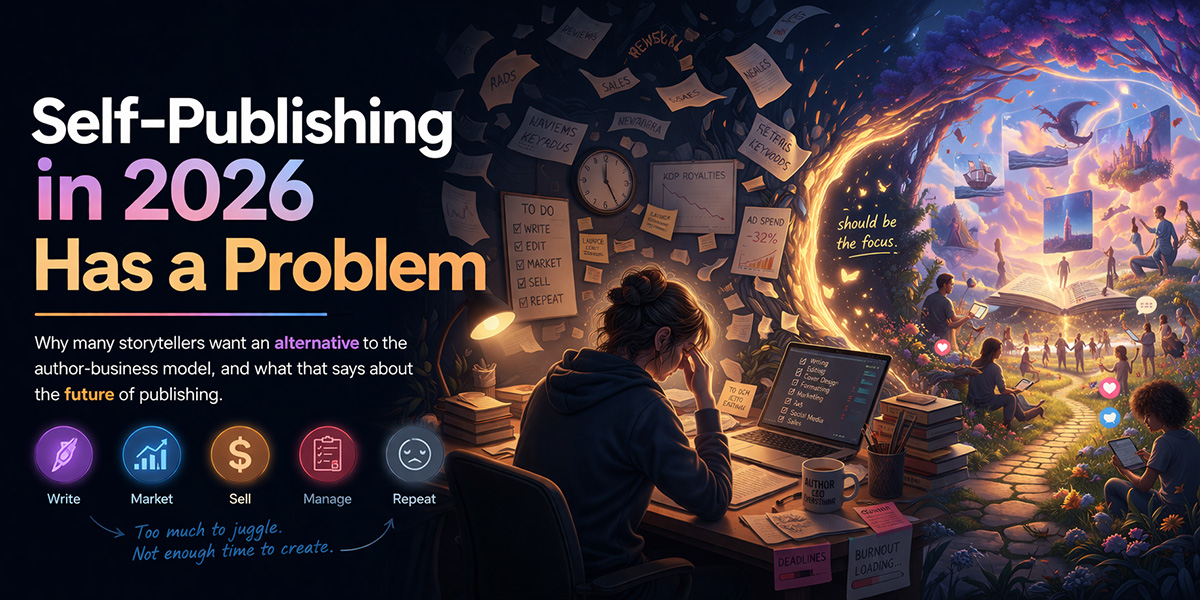
Self-Publishing in 2026 Has a Problem
Why many storytellers want an alternative to the author-business model, and what that says about the future of publishing.
There is a question I think the self-publishing world asks too rarely.
What if I just wanted to tell stories?
Not build a brand. Not optimise a funnel. Not become an email marketer with a side interest in fiction. Not spend my evenings learning ad dashboards, newsletter automations, retailer algorithms, metadata strategy, and the theological differences between going wide and staying exclusive with KDP.
What if I just wanted to write stories, share them, and have them read?
That question has been rattling around in my head for a while now. And the reason it matters to me is that I didn’t arrive in this world with a masterplan. I sort of wandered into it by accident.
In 2016, I was on a plane to Berlin when a scene came into my head.
I was bored, which is often when the brain decides to become wildly overconfident. So I opened the notes app on my phone and wrote the scene down. Two weeks later, on the way back, it happened again. Another scene. More ideas. A growing sense that something was there.
And then I had a thought that, in hindsight, was either creatively brave or deeply inconvenient:
Maybe I could write a book.
I had written plenty in my life, but never a novel. I had no understanding of the publishing industry, no map of how books got into the world, and absolutely no dream of becoming an entrepreneurial author brand. I just had an idea that seemed too interesting to ignore.
So I started looking into it.
That was when I discovered self-publishing.
Or, more precisely, I discovered that self-publishing was even a thing. KDP. Kindle Direct Publishing. The fact that ordinary people could write books, package them, upload them, and put them into the marketplace without waiting for a gatekeeper to nod solemnly from behind a mahogany desk.
That was thrilling.
And to be fair, it still is.
But once I got past the initial excitement, I started to notice something else. A kind of quiet default assumption built into the entire ecosystem.
It went like this: if you are self-publishing, then obviously your real ambition is to make serious money from it.
Obviously you want to become professional. Obviously you want to grow an audience at scale. Obviously you want to build a catalogue, build a brand, build a mailing list, build a business, build a reader acquisition machine, and if possible, build a life in which your novels pay for your groceries while you smile knowingly into the middle distance.
And again, to be clear, for some people that is exactly what they want. That path is real. It is valid. Some authors pursue it brilliantly.
But that isn’t everyone.
And I suspect it isn’t even most.
I think a great many people come into self-publishing for a much simpler reason. They have stories they want to tell. Stories they want to shape, finish, share, and put in front of readers. Maybe they would like to earn a bit of money too. Of course they would. Why shouldn’t they?
But the story is the point.
The money, if it comes, is secondary.
And that is where I think self-publishing in 2026 has become oddly warped.
Because if you look at the landscape now, it is absolutely crammed with tactics.
Everything is tactics.
There are tactics for planning. Tactics for plotting. Tactics for outlining. Tactics for writing faster. Tactics for writing cleaner. Tactics for using AI. Tactics for avoiding AI. Tactics for editing. Tactics for cover design. Tactics for blurbs. Tactics for metadata. Tactics for categories. Tactics for newsletter growth. Tactics for launch teams. Tactics for ARC readers. Tactics for promo stacking. Tactics for Facebook ads. Tactics for Amazon ads. Tactics for TikTok. Tactics for Instagram. Tactics for hooks, funnels, offers, lead magnets, direct sales, read-through, and the precise spiritual alignment of your back matter links.
You begin by wanting to write a novel and end up needing the operational instincts of a small logistics company.
And the infrastructure around it all is enormous.
If you want to create the book, there are plotting tools, worldbuilding tools, corkboard apps, character bibles, beat-sheet systems, drafting software, editing software, grammar tools, critique groups, productivity communities, writing coaches, AI assistants, and whole content economies devoted to teaching you how to become the sort of person who colour-codes emotional arcs in Notion.
If you want to publish the book, there are formatters, cover designers, blurb copywriters, genre consultants, launch specialists, metadata experts, ad managers, and approximately four million online opinions about what you are doing wrong.
If you want anyone to actually notice the book, that is when things become properly exhausting.
Now you need a website. A newsletter. A sign-up incentive. A lead magnet. A reader magnet. A mailing sequence. Social channels. A content calendar. A promo strategy. A launch plan. A review plan. A community strategy. A posting rhythm. A growth strategy. A presence.
And behind all of it, the same relentless message:
More effort. More cost. More learning. More optimisation.
Very little of which is the story itself.
That, I think, is the bit that too often goes unsaid.
For many people, the self-publishing journey becomes less about telling stories and more about maintaining the giant commercial exoskeleton that has grown around the act of telling them.
You set out wanting to write fiction. Somehow, six months later, you are comparing email service providers and wondering whether your author website should have a resources page.
And perhaps it should. But that’s hardly why you started.
The strangest part is that writing the book, which initially feels like the mountain, can end up being just the admission fee. If your goal is commercial success, it is often only the beginning.
Because then comes discoverability.
How do readers find you? How do they hear about the book? How do you get noticed in a marketplace with far more books than available attention? How do you build an audience? How do you keep them? How do you turn one sale into another? How do you compete in a space where visibility is often rented rather than earned?
This is where self-publishing stops feeling like a creative route and starts feeling like a tactical obstacle course.
And then, finally, there is monetisation.
Which is where many people discover that their “author business” is, in practical terms, a hobby with invoices.
The market is crowded. Paid visibility often matters. Organic discovery is unpredictable. Reader attention is fragmented. Retail platforms are noisy. The competition is relentless. And unless you are both persistent and commercially minded and willing to treat the whole thing as a long-term business project, the financial outcomes are often underwhelming.
I can say that without bitterness because I’ve lived it.
I’ve sold around 20,000 books. I’ve made something like $11,000 in income. I’ve also probably spent around $15,000 on marketing, promotion, software, services, events, and all the various trimmings that gather around self-publishing when you try to take it seriously.
Now, I don’t regret any of that. I’ve enjoyed it. I’ve learned a huge amount. I’ve had the genuine pleasure of putting stories into the world and seeing readers engage with them.
But if we are calling things by their proper names, this has not been a business.
It has been a hobby. A rich and rewarding hobby, yes. But still a hobby.
And there is nothing wrong with that.
The problem is not that so many people are doing this like a hobby. The problem is that the ecosystem often talks as though everybody should be trying to turn it into a business.
They shouldn’t.
Many people are doing this around day jobs. Around family responsibilities. Around limited time, limited energy, limited spare money, and already overloaded lives.
Which means their resources are precious.
And when your time and money are genuinely scarce, it matters enormously where they go.
If your real goal is to tell stories and share them, then surely you want those scarce resources going into the story itself. Into the idea. Into the characters. Into the emotional truth of the thing. Into the world you are trying to build. Into the act of creation.
Not into endlessly learning adjacent disciplines you never wanted to master in the first place.
Not into websites, automations, ads, promotions, analytics, endless social content, and that low-level feeling that you are somehow always behind because you have not yet watched the latest webinar on converting newsletter subscribers into super-readers.
And yet that is the route self-publishing so often presents.
Traditional publishing is viable for a tiny slice of people. Self-publishing is much more open, but the dominant version of it increasingly assumes that if you come in, you are prepared to become not just a storyteller, but a marketer, a publisher, a content strategist, a systems thinker, and a mildly overworked operator.
That works for some.
It is completely wrong for others.
And I think that second group is much larger than the industry likes to admit.
Because meanwhile, outside the standard self-publishing bubble, stories are already thriving in other kinds of ecosystems.
Wattpad. Royal Road. Fanfiction communities. Social storytelling spaces. Reader communities built around comments, lists, recommendations, fandoms, serial discovery, niche tastes, and ongoing engagement.
These platforms matter because they prove something important: many readers do not simply want to buy a finished product from a digital shelf and vanish quietly into the night. They want stories to be social. Immediate. Abundant. Community-shaped. Shared through people, not just platforms.
That is a very different model of storytelling culture.
But even those spaces still often preserve an old distinction: there are the people who create the stories, and the people who consume them.
And I’m not convinced that’s how the world works in 2026 either.
I think almost everybody has a story in them.
Some won’t write it in the old-fashioned sense. Some won’t ever think of themselves as “writers.” Some will not want to spend years learning craft to a professional standard. Some will not want the commercial grind. Some will simply want a way to express something imaginative and put it into the world.
That should count for more than it does.
Because stories are not just products. They are one of the oldest things human beings do. We use them to share knowledge, to transmit culture, to entertain, to warn, to teach, to make sense of pain, to build empathy, to carry memory, to imagine futures, and to connect people who would otherwise never understand one another.
That should not be reserved only for people willing to fight their way through a sprawling, expensive, commercial publishing maze.
It should be more open than that.
That is why I’m building StorySparx.
Because I think there should be another route. A route for people who want to bring stories to life and share them without needing first to become a full-blown author-business. A route for people who are creative, imaginative, full of ideas, but who never asked to become experts in funnel design and audience monetisation.
A place where you do not have to be a writer in the old industry sense.
You just need a story.
If you can articulate that story, StorySparx is designed to help bring it into the world and connect it with a community of people who love stories.
That feels, to me, much closer to where storytelling is actually heading.
Not away from books. Not away from authors. Not away from craft.
But toward something broader.
More open. More social. More participatory. More human.
A future in which storytelling is not treated only as a commercial product pipeline, but as something ordinary people should be able to do because they have something to imagine and something worth sharing.
Not everybody wants to build a publishing empire.
Some people just want to tell a story.
I think self-publishing forgot that for a while.
And I think it’s time we remembered.